
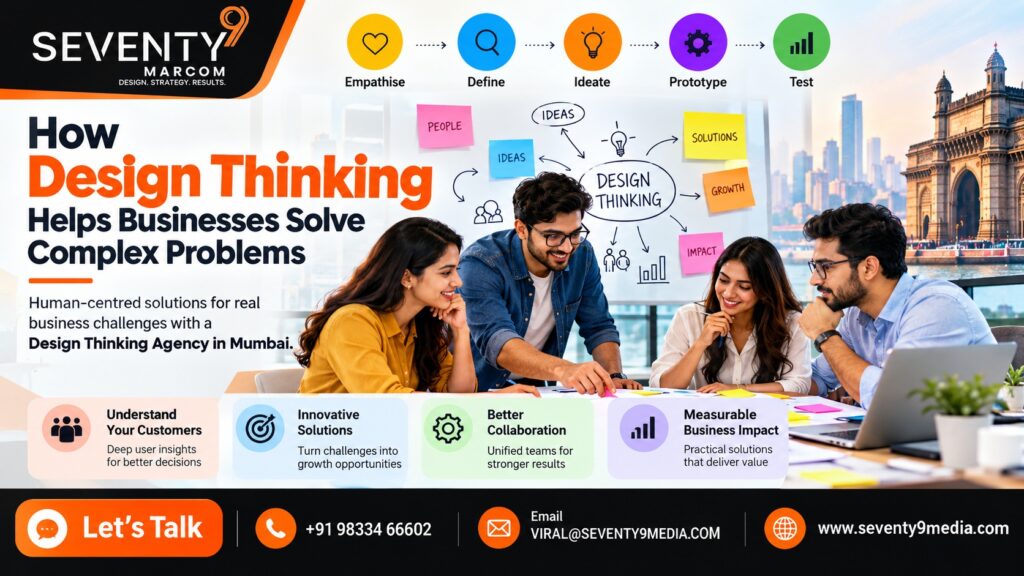
In today’s competitive business environment, organisations face increasingly complex challenges, from changing customer expectations and operational inefficiencies to digital transformation and market competition. Traditional problem-solving methods often focus on immediate symptoms rather than understanding the underlying causes. This is where design thinking becomes valuable. It offers a human-centred, structured approach that helps businesses understand problems, develop innovative solutions, and create meaningful customer experiences.
A professional Design Thinking Agency in Mumbai can help businesses approach challenges from a fresh perspective by combining customer research, strategic thinking, creativity, and experimentation. Instead of relying solely on assumptions, businesses can make informed decisions based on real customer needs and measurable business objectives.
For organisations looking to improve products, services, processes, and customer relationships, design thinking provides a practical framework for turning complex challenges into opportunities for sustainable growth.
What Is Design Thinking and Why Does It Matter for Businesses?
Design thinking is a problem-solving methodology that places people at the centre of the innovation process. It encourages businesses to understand their customers, challenge existing assumptions, explore multiple ideas, and test potential solutions before committing significant resources.
Unlike conventional approaches that may prioritise internal processes or short-term outcomes, design thinking considers how customers experience a product, service, or business interaction. This approach helps organisations identify gaps between what they offer and what their audiences genuinely need.
Businesses can apply design thinking to website development, digital products, customer service, marketing strategies, internal workflows, and new product development. Its flexible nature makes it relevant across industries, including healthcare, finance, retail, education, manufacturing, and technology.
By working with a Design Thinking Company in Andheri East, businesses can explore challenges systematically while maintaining a strong focus on customer satisfaction, operational efficiency, and long-term business value.
Five Stages of Design Thinking for Solving Complex Problems
Design thinking commonly follows five interconnected stages: empathise, define, ideate, prototype, and test. These stages provide a structured process, although teams may revisit earlier stages when new information emerges.
Empathise — Understand Your Customers
The first stage involves understanding the people affected by a particular problem. Businesses collect insights through customer interviews, surveys, observation, usability studies, and customer journey analysis.
For example, if customers abandon an online enquiry form, the issue may not be a lack of interest. Complicated questions, unclear instructions, slow loading times, or concerns about sharing personal information could be contributing factors. Customer research helps uncover these barriers.
Define — Identify the Real Problem
Once customer insights have been gathered, the next step is to translate them into a clearly defined problem statement. A precise problem definition prevents teams from investing time and money in solutions that address the wrong issue.
For instance, rather than defining the problem as low website conversions, a business might identify that customers struggle to understand the service offering before submitting an enquiry. This creates a clearer direction for improvement.
Ideate — Explore Innovative Solutions
During ideation, teams generate different approaches without immediately committing to the first idea. Brainstorming, collaborative workshops, competitor-independent customer research, and creative problem-solving exercises can reveal opportunities that conventional thinking might overlook.
A Design Thinking Agency in Mumbai can facilitate these sessions to help business leaders, designers, marketers, and operational teams contribute different perspectives to the same challenge.
Prototype and Test — Validate Before Scaling
Prototyping transforms promising ideas into something that customers and stakeholders can evaluate. Depending on the project, a prototype could be a website wireframe, service blueprint, interactive mock-up, process simulation, or basic product model.
Testing these prototypes helps organisations gather feedback, identify usability issues, and refine the solution before a full-scale launch. This iterative process can reduce uncertainty and help teams allocate resources more effectively.
How Design Thinking Helps Businesses Overcome Complex Challenges?
Complex business problems rarely have one obvious solution. They often involve multiple stakeholders, competing priorities, limited resources, and rapidly changing customer expectations. Design thinking helps organisations address these challenges by combining research, collaboration, experimentation, and continuous improvement.
Improving Customer Experience
Customer experience extends beyond the purchase itself. It includes every interaction customers have with a brand, from discovering a service and navigating a website to receiving support after a transaction.
Through Customer Experience Design Consulting Mumbai, businesses can examine customer journeys, identify friction points, and redesign interactions to make them more intuitive. Better navigation, clearer communication, simpler forms, and consistent service experiences can improve customer confidence and satisfaction.
Encouraging Innovation and Better Decisions
Design thinking creates an environment where teams can challenge assumptions and evaluate alternative solutions. Instead of relying entirely on seniority or intuition, organisations can use customer evidence and prototype testing to guide decisions.
This approach supports product innovation, service improvements, digital transformation, and the development of new business models.
Reducing Unnecessary Costs and Risks
Launching an untested solution can lead to expensive revisions, low adoption, and wasted resources. Design thinking encourages businesses to test ideas on a smaller scale before investing in full implementation.
Early validation can reveal weaknesses when changes are easier and less expensive to make. Although it cannot eliminate business risk, it can help organisations identify potential problems sooner.
Strengthening Cross-Functional Collaboration
Complex problems frequently cross departmental boundaries. Marketing may focus on lead generation, sales on conversions, technology on performance, and customer support on resolving complaints.
Design thinking brings these perspectives together around a shared understanding of the customer problem. This encourages stronger collaboration, clearer priorities, and solutions that work across the wider organisation.
Business Applications of Design Thinking
| Business Area | Common Challenge | Design Thinking Application | Potential Outcome |
|---|---|---|---|
| Digital products | Low user engagement | User research and usability testing | Improved usability |
| Marketing | Low-quality enquiries | Customer journey mapping | More relevant customer journeys |
| Customer service | Repeated complaints | Service blueprinting | Smoother service delivery |
| Product development | Uncertain customer demand | Prototyping and validation | Better-informed product decisions |
| Internal operations | Inefficient workflows | Employee interviews and process mapping | Reduced friction |
| E-commerce | Cart abandonment | Checkout journey testing | Fewer usability barriers |
These applications demonstrate how design thinking can support different business functions. Actual outcomes depend on the quality of research, implementation, customer adoption, and ongoing measurement.
Why Businesses Need Professional Design Thinking Services in Mumbai?
Mumbai’s dynamic business environment requires organisations to respond to changing consumer behaviour, digital expectations, and competitive pressures. Businesses need solutions that address immediate operational concerns while supporting their long-term strategic goals.
Professional Design Thinking Services in Mumbai can provide the research, facilitation, design expertise, and testing processes required to investigate complex challenges. An experienced team can help translate broad business objectives into specific problem statements, actionable concepts, and testable solutions.
A structured engagement may begin with stakeholder discussions and customer research, followed by journey mapping and problem definition. The team can then develop potential solutions, create prototypes, conduct testing, and recommend improvements based on the findings.
For businesses in Andheri East and across Mumbai, this approach can be particularly valuable when improving digital platforms, redesigning customer-facing services, developing new offerings, or aligning internal teams around a shared vision.
The goal is not simply to make a product look attractive. It is to create solutions that are useful to customers, practical for employees, technically feasible, and aligned with business objectives.
Design Thinking vs Traditional Problem-Solving
| Comparison Factor | Traditional Problem-Solving | Design Thinking |
|---|---|---|
| Starting point | Existing assumptions or defined requirements | Customer and stakeholder understanding |
| Research approach | Often focused on available operational data | Combines qualitative and quantitative insights |
| Idea development | May prioritise familiar solutions | Encourages multiple possible solutions |
| Validation | May happen late in development | Uses early prototypes and feedback |
| Collaboration | Often follows departmental structures | Encourages cross-functional participation |
| Improvement | May focus on final implementation | Supports iterative refinement |
Neither approach is universally suitable for every situation. Design thinking is particularly useful when a problem is ambiguous, customer needs are changing, or the right solution is not immediately clear. Established procedures may remain more appropriate for predictable tasks with clearly defined requirements.
How to Measure the Impact of Design Thinking?
To understand whether a design thinking initiative is delivering value, businesses should establish measurable objectives before starting the project. Metrics should reflect the original problem rather than relying only on the number of workshops conducted or ideas generated.
For digital products, useful measures may include task completion rates, conversion rates, customer satisfaction, and usability testing results. For customer service, organisations may track complaint frequency, resolution time, and customer feedback.
Businesses improving internal operations can measure process completion time, employee feedback, error rates, and operational costs. Product development teams may assess prototype success, feature adoption, and feedback from early users.
Regular reviews help organisations determine which changes are working and where further improvements are needed. A Design Thinking Agency in Mumbai can help establish an appropriate measurement framework and connect design decisions with business outcomes.
Conclusion — Turn Complex Problems into Opportunities
Design thinking helps businesses move beyond assumptions and develop a deeper understanding of the people they serve. By combining empathy, structured problem definition, creative exploration, prototyping, and testing, organisations can discover practical solutions to complex challenges.
Whether the objective is to improve digital experiences, develop innovative products, simplify internal processes, or strengthen customer relationships, a human-centred approach can support more informed decisions and continuous improvement.
Partnering with a Design Thinking Company in Andheri East can help businesses build a repeatable process for understanding customer needs and evaluating potential solutions. With the right research, collaboration, and performance measures, design thinking becomes more than a creative exercise: it becomes a practical approach to business innovation.
Frequently Asked Questions (FAQs)
1. What does a Design Thinking Agency in Mumbai do?
A Design Thinking Agency in Mumbai helps businesses understand customer needs, identify underlying problems, develop innovative ideas, create prototypes, and test solutions. Its services may support digital product design, customer experience improvement, business innovation, and service development.
2. What are the main benefits of design thinking for businesses?
The main benefits include a better understanding of customers, improved collaboration, more informed decision-making, early identification of usability issues, and opportunities to reduce the risks associated with untested solutions.
3. Which businesses can benefit from Design Thinking Services in Mumbai?
Start-ups, small businesses, established companies, and enterprises can benefit from design thinking. It can be applied across industries such as technology, healthcare, finance, education, retail, manufacturing, and professional services.
4. How can a Design Thinking Company in Andheri East improve digital products?
A design thinking company can conduct user research, map customer journeys, identify usability problems, create wireframes, test prototypes, and recommend improvements that make digital products easier to understand and use.
5. What is Customer Experience Design Consulting Mumbai?
Customer Experience Design Consulting Mumbai refers to professional support for evaluating and improving the interactions customers have with a business. It may involve customer journey mapping, service design, user research, experience strategy, and usability evaluation.
6. How long does a design thinking project take?
The timeline depends on the complexity of the challenge, research requirements, stakeholder availability, and testing scope. A focused discovery or prototype exercise may take a few weeks, while a wider organisational transformation may require several months.
7. Is design thinking suitable for small businesses?
Yes. Small businesses can use design thinking to understand customers, validate new service ideas, improve websites, simplify processes, and prioritise investments. The process can be scaled to suit available budgets and resources.
8. How can businesses measure design thinking success?
Businesses can measure success using relevant indicators such as customer satisfaction, conversion rates, task completion, service resolution time, product adoption, operational efficiency, and project-specific business outcomes.